
Knauf Radiant Barrier Installation: The Cedar Park Owner’s Guide
Knauf radiant barrier installation in Cedar Park typically runs $1.80 to $2.40 per square foot of attic deck, with most single-family homes falling between $1,400 and $2,200 for a complete install. We stock Knauf EcoSeal and Insulation Shield radiant barrier products on our Cedar Park trucks, and most jobs can be scheduled within 48 hours. Homeowners usually figure out something’s wrong when their upstairs AC can’t keep up past 3 p.m. in July, or they notice the foil they paid for five years ago is dangling in strips from the ridge line.
Which Knauf Models This Applies To
Knauf manufactures two radiant barrier systems you’re likely to find in Cedar Park attics: the EcoSeal Foil-Faced Insulation, which integrates a perforated aluminum facing onto fiberglass batts, and the standalone Insulation Shield radiant barrier foil, a double-sided reinforced product sold in 4-foot rolls for staple-up application across rafters or truss chords.
To identify what you’ve got, check the foil facing for stamped markings. EcoSeal carries a Knauf logo and R-value stamp every 24 inches. Insulation Shield has a dot-matrix batch code and “ASTM C1313” printed along one edge. If you’re seeing unmarked silver foil, it may be a generic equivalent that was substituted during a prior install. That’s common in Cedar Park’s fast-build phases from 2018 to 2022, when some crews used commodity foil to hit price points.
We’re an independent service provider with no affiliation to Knauf. We source their products through authorized distribution, but we also carry Reflectix if your attic configuration or budget points that direction. The choice between OEM Knauf and quality equivalent depends on your existing insulation assembly and whether you need the perforation rating that Knauf specifies for Cedar Park’s humidity zone.
Signs Your Knauf Radiant Barrier Installation Is Failing
- Upstairs rooms run 8 to 12 degrees hotter than downstairs by late afternoon. The radiant barrier’s aluminum surface oxidizes or collects dust over time, dropping its reflectivity from the original 95 percent to 60 percent or lower. In Cedar Park, where attic temperatures hit 140°F regularly from May through September, that degradation accelerates.
- Foil facing is torn, sagging, or detached from rafters. Knauf Insulation Shield relies on proper staple spacing and furring strips; when installers skip the strips or use the wrong staple gauge, gravity and attic heat cycling pull the foil loose within three to five years.
- Your summer electric bills have climbed 15 to 25 percent year-over-year with no rate change. A failing radiant barrier forces your HVAC to run longer to reject radiant heat gain through the roof deck. We see this pattern most often in Cedar Park homes with dark architectural shingles and inadequate soffit ventilation.
- Moisture staining on the foil or surrounding framing. Knauf’s perforated products allow vapor transmission; if a previous installer used non-perforated foil in a vented attic, condensation forms on the underside and breeds mold. This is a compatibility gotcha we catch during pre-install inspections.
- The foil looks dull gray instead of bright reflective silver. Aluminum oxide buildup is irreversible. Once the surface emissivity rises above 0.20, the barrier is no longer doing meaningful work. Dust accumulation in Cedar Park’s limestone-dust environment compounds this faster than in coastal Texas markets.
Replacement Cost & What’s Included
Most Knauf radiant barrier replacements in Cedar Park fall between $1,400 and $2,200 for attics between 1,200 and 2,400 square feet of floor area. The per-square-foot range is $1.80 to $2.40, with the final figure driven by three factors: whether we need to remove failed existing foil, the accessibility of your roof pitch, and whether your attic needs air sealing before the new barrier goes in.
Every quote is itemized. You’ll see line items for material (Knauf or Reflectix, your choice), labor, removal and disposal of old product, and the blower-door test if we’re sealing the attic floor as part of the same job. Under Haven Standard Clause 1, that written price is locked before anyone enters your attic. The 365-Day Done Right Promise covers all completed work, and you’ll receive a Documented Photo Record showing before, during, and after conditions.
We do not install radiant barrier over an unsealed attic floor. Seal the leaks first. Then insulate. The order matters more than the product.
DIY or Call Us?
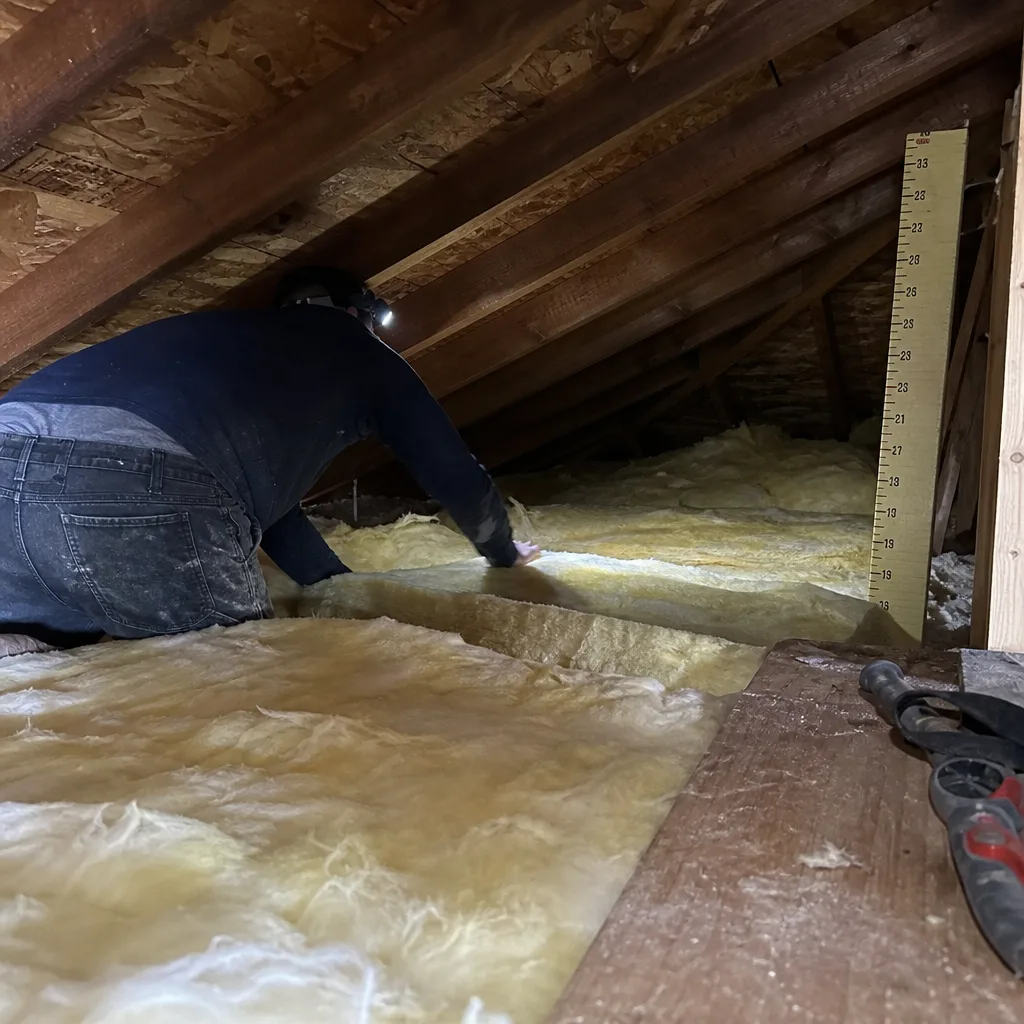
There’s nothing inherently dangerous about handling Knauf radiant barrier foil. It’s lightweight, non-toxic, and requires no special tools beyond a staple gun and proper PPE for attic work. What goes wrong is the prep: homeowners staple foil over unsealed top plates, can lights, and duct chases, trapping conditioned air leaks behind a reflective surface that now acts as a vapor barrier in the wrong place.
You can safely check your attic for the symptoms we listed above. Note the foil condition, take photos of any stamped markings, and measure your attic floor area. But if you’re considering replacement, call us. We’ll run a blower-door test - a pressurization reading that shows, in one number, how much air your building envelope is losing - and hand you a written scope with actual ACH50 numbers before we quote the barrier install. That’s the discipline Wes Okafor learned running hands-on audits at Olive-Harvey College’s building science program, and it’s what we bring to every Cedar Park job.
Call (737) 245-6428 for a free estimate. Estimates include the infiltration test and a written price before any work starts.
FAQs
In Cedar Park’s climate, a properly installed Knauf radiant barrier maintains effective performance for 15 to 25 years. Attic heat, UV exposure through ridge vents, and limestone dust accumulation are the main degrading factors. Call (737) 245-6428 and we’ll inspect your current install and tell you where it sits in that range - estimates are free.
Small tears can be patched with matching foil tape, but sagging, oxidation, or widespread detachment means replacement. Patchwork in a 140°F attic rarely holds, and the labor to repair often approaches replacement cost. Call (737) 245-6428 for an honest assessment - we’ll show you photos of what we find and give you a written price for either approach.
Most residential installs in Cedar Park take one day, assuming standard truss spacing and clear attic access. Homes with steep pitches, limited scuttle openings, or significant old-foil removal may extend to a second day. We schedule with a named technician and text you when they’re en route.
We stock Knauf EcoSeal and Insulation Shield products, plus Reflectix equivalents, on our Cedar Park-based trucks. For non-standard widths or specialty perforated ratings, we pull from Austin-area distribution with a 24- to 48-hour lead time. Call (737) 245-6428 to confirm availability for your specific model - we’ll match it to your existing assembly.
Written by Wes Okafor, Owner, Topside Attic Insulation Cedar Park at Topside Attic Insulation Cedar Park, serving Cedar Park and nearby areas.