
GreenFiber Blown-In Insulation in Cedar Park: What to Know First
We install and service GreenFiber blown-in insulation in Cedar Park as an independent GreenFiber service provider, with most attic jobs completed in one day and pricing put in writing before any work starts. Most Cedar Park homes we see need blown-in cellulose top-ups or full replacement runs in the $2,800-$5,400 range, depending on attic square footage and whether the existing layer has compressed or settled. This page is for homeowners who already have GreenFiber in their attics or walls and need honest answers about what’s failing, what it’ll cost to fix, and whether the work will hold up under Central Texas heat.
Call (737) 245-6428 for a free estimate. A live person answers 24/7.
How GreenFiber Products Fail - and How We Fix Them
- GreenFiber Sanctuary settled below labeled R-value in vaulted ceilings. Sanctuary’s loose-fill cellulose is treated with borate fire retardant, but in Cedar Park’s zero-lot-line homes with shallow pitch roofs, the product settles 15-20% in the first three years when installers skip the stabilization netting. We remove the compressed layer, install proper retention netting, and re-blow to the original design depth with documented depth markers left in the attic.
- GreenFiber All Borate loose-fill washes out around soffit baffles after heavy rain. The borate treatment resists mold but doesn’t bind fibers against wind-driven moisture that enters through poorly sealed soffits, a common issue in Cedar Park’s older Ranch at Deer Creek and Buttercup Creek builds. We pull back the affected material, seal the soffit perimeter with fire-rated caulk, and reinstall with baffle extensions that keep airflow above the insulation plane.
- GreenFiber stabilized cellulose clumps from roof leak saturation. The added acrylic binder in stabilized products turns to dense matting when attic leaks go undetected, creating cold spots that show up on infrared scans. We spot-remove the clumped sections, treat the deck for mold if needed, repair the leak source, and replace with fresh loose-fill matched to the original spec.
- GreenFiber dense-pack walls sag in balloon-framed Cedar Park cottages. Pre-1980s homes near the old downtown core have continuous wall cavities without fire blocking, and dense-pack cellulose migrates downward over time if the pack density drops below 3.5 pounds per cubic foot. We re-dense with a higher-pressure blow, add mid-height blocking where code allows, and verify with a wall-cavity density probe.
- GreenFiber subflooring insulation in crawl spaces compresses from foot traffic during HVAC service. Homeowners in the newer Cedar Park subdivisions with conditioned crawl spaces often find their GreenFiber batt or loose-fill crushed where technicians have crawled. We replace with a higher-density stabilized product and install walk boards over traffic paths so the insulation keeps its loft.
Our GreenFiber Blown-In Insulation Process
- 1
Pre-install blower-door test. We pressurize the house and measure CFM50 - the airflow at 50 Pascals of pressure - to establish a baseline of how leaky the envelope is before we touch anything.
- 2
Air sealing of top plates, can lights, and penetrations. We seal every gap with fire-rated caulk or foam, because blowing insulation over an unsealed attic floor is something we simply don’t do. Seal the leaks first. Then insulate. The order matters more than the product.
- 3
GreenFiber product selection. We match the original spec where possible, but we’ll specify OEM-equivalent or upgraded density if the original installation failed due to under-spec application. No proprietary lock-in.
- 4
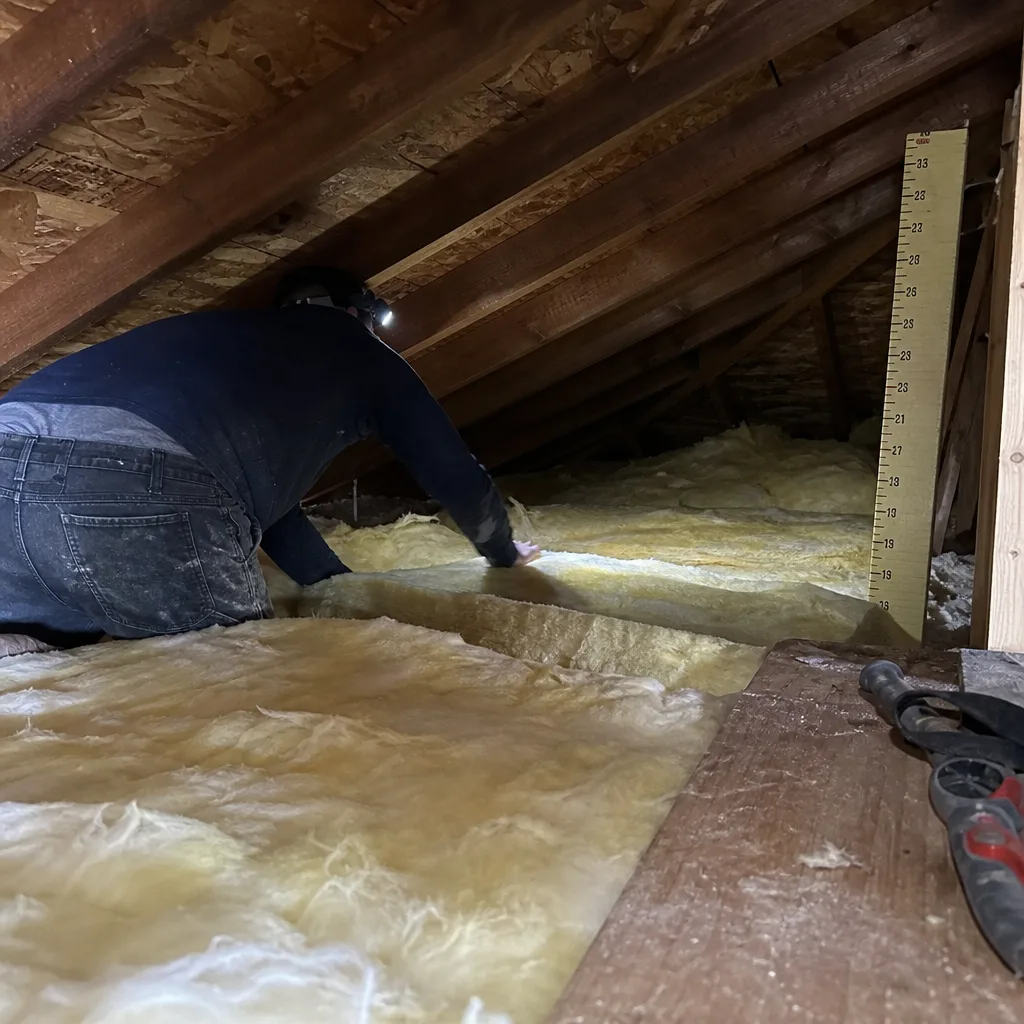
Installation with depth markers and density verification. We install depth rulers every 300 square feet and verify coverage with a thermal camera before we leave.
- 5
Post-install blower-door test and documentation. We run the pressurization test again, record the ACH50 improvement, and hand you the written before-and-after report with photos.
- 6
Cleanup and written warranty delivery. The crew vacuums the work path, and you get the Haven Standard written scope and 365-Day Done Right Promise before anyone leaves.
What GreenFiber Blown-In Insulation Costs in Cedar Park
| Job Type | Typical Range | What Moves the Price |
|---|---|---|
| GreenFiber loose-fill top-up (1,200-1,800 sq ft attic) | $2,800-$3,900 | Current depth, access difficulty, whether old material needs removal |
| GreenFiber full attic replacement with air sealing | $4,200-$5,400 | Square footage, number of can lights to seal, deck repair needs |
| GreenFiber dense-pack wall insulation (per wall) | $1,800-$2,800 | Cavity height, interior vs exterior access, existing insulation removal |
| GreenFiber crawl space replacement | $2,200-$3,600 | Crawl height, moisture barrier condition, vapor barrier replacement |
These are real Cedar Park numbers based on jobs we’ve run in Buttercup Creek, Ranch at Deer Creek, and the older neighborhoods near Whitestone Boulevard. Every estimate is a written price before any work starts - Haven Standard Clause 1 - and we offer a free second opinion on any competing written quote. Call (737) 245-6428 for your exact number.
Why Cedar Park Homeowners Call Topside Attic Insulation Cedar Park for GreenFiber Work
We’ve sealed and insulated 9,000+ homes since 2016, and the ones in Cedar Park teach you something specific. Attics here hit 140°F by mid-July, and insulation that was adequate in a cooler climate compresses faster than the manufacturer charts suggest. Wes Okafor brought blower-door discipline from Chicago’s building science program at Olive-Harvey College, and that means we measure before we guess.
Our technicians are background-checked and uniformed, and a live person answers (737) 245-6428 around the clock. We also service Reflectix and other major brands, so if your GreenFiber system needs a hybrid solution, we’re not locked into a single product line. Every job closes with a Documented Photo Record and, on applicable work, before-and-after blower-door numbers you can verify yourself.
FAQs
GreenFiber’s product warranty covers manufacturing defects regardless of who installs it, but coverage for application-related issues like settling or washout typically requires documentation of proper installation depth and density. We provide that documentation - depth photos, coverage maps, and written specs - on every job, which most homeowners have found sufficient for warranty claims. Call (737) 245-6428 and we’ll review your specific product line and warranty terms before we start.
Yes. GreenFiber cellulose is widely distributed through regional building supply houses, and we source from the same channels without proprietary restrictions. For older GreenFiber stabilized formulations that are no longer manufactured, we match the R-value and density spec with current OEM-equivalent product and note the substitution in your written scope. Bring us any existing paperwork and we’ll sort out what’s available.
Repair is cheaper if the settlement is localized and the remaining material tests clean for moisture and pest intrusion - typically 30-40% less than full replacement. If the settled layer is below 50% of original depth across more than 60% of the attic, or if we find compressed clumps from past leaks, full removal and re-blow is the only fix that meets the R-value you paid for. We’ll show you both numbers in writing before you decide.
Most GreenFiber service calls are scheduled within 48 hours, and emergency situations - saturated insulation from an active roof leak, for example - get same-day response. A live person answers (737) 245-6428 24/7, and you’ll get a text when your named technician is on the way. Under Haven Standard: Arrive on schedule, you get a named technician and a text when they are on the way.
Only if the old layer is dry, uncompressed, and the attic floor is already air-sealed. Blowing new cellulose over settled, leaky insulation traps moisture and masks the real problem. We test with a moisture meter and blower-door test first; if the existing GreenFiber is viable, we’ll top up to the proper depth. If not, we quote removal and start clean. The written price covers whichever path the testing dictates.
Written by Wes Okafor, Owner, Topside Attic Insulation Cedar Park at Topside Attic Insulation Cedar Park, serving Cedar Park and nearby areas.